JEFF
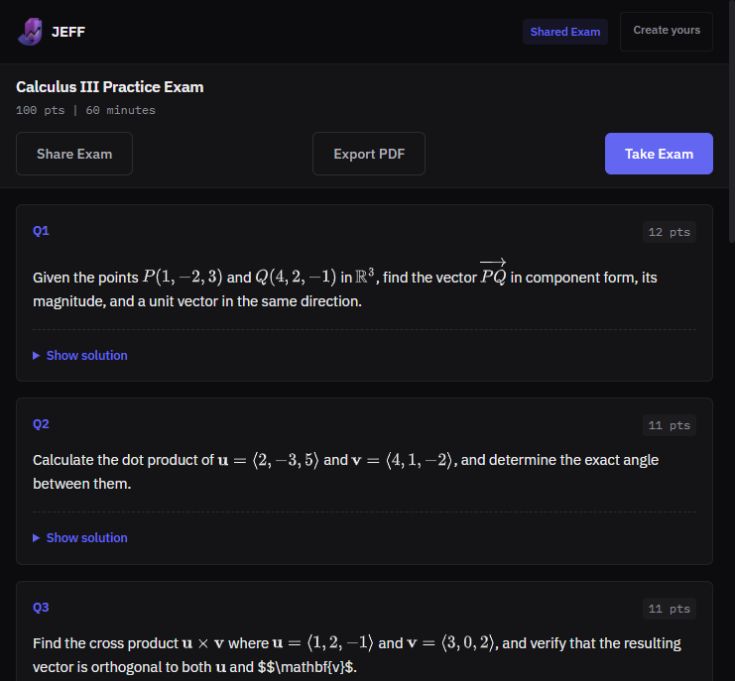
Course materials become targeted practice exams, with a separate plan, generation, and verification workflow.
“What if practice felt more like the exam you are preparing for?”
The question
A LinkedIn post about Gemini anticipating exam questions made me wonder whether course materials could support more useful practice. The goal was relevant question types and topic emphasis, rather than another generic quiz generator.
The first attempt
Simply asking a model to write an exam leaves too much implicit. I iterated on document handling and structured instructions, distinguishing past exams, solutions, notes, and review sheets. A solution sheet can reveal reasoning depth without counting as another exam on the same topic.
The system
An analysis step proposes a blueprint of question slots, topics, points, format, difficulty, and estimated time. A separate generation step follows that plan. Structural checks, source-reuse checks, repair, and solution verification make failures easier to inspect. The application also handles mathematical rendering, practice, review, export, and sharing.
The complications
Plausibility is not forecasting accuracy. JEFF can estimate emphasis and question style from supplied evidence, but cannot know an instructor’s unseen exam. A passing formatting test does not prove a reliable exact-question prediction rate.
The result
JEFF became part of my study routine and was used by more than 50 students, as documented in my résumé. Requests from classmates for physics practice led to share links. The project study distinguishes actual use from the limits of its evaluation.
The next question
How do you test a prediction when the outcome is still unseen? This connects JEFF to model verification and the uncertainty explored in The Terrarium.